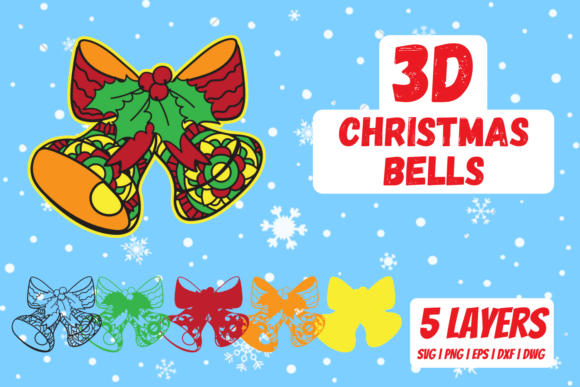
3D Christmas Bells: More Than Holiday Decor—A Practical Creative Asset
If you’ve ever spent hours trying to make a holiday email banner feel festive—not just “red and green with snowflakes”—you know the difference between flat graphics and something that pops. 3D Christmas Bells aren’t just decorative models for a digital tree; they’re versatile, production-ready assets used across design, education, marketing, and small business workflows. Think of them as dimensional building blocks: ready to drop into a scene, animate with subtle motion, integrate into AR previews, or even 3D-print for physical displays.
What Exactly Are 3D Christmas Bells?
At their core, 3D Christmas Bells are digital models—typically in formats like .glb, .fbx, or .obj—that render with realistic depth, lighting response, and material properties (metallic sheen, aged brass texture, translucent red enamel). Unlike static PNGs or SVGs, they respond to light direction, camera angle, and animation timelines. Most include clean topology, UV-mapped textures, and PBR (Physically Based Rendering) materials—so they look convincing whether embedded in a Shopify product page or rotated live on an Instagram Story.
For Small Business Owners Building Festive Product Pages
A local candle maker launching a limited-edition “Winter Bell” soy wax blend doesn’t need a full photoshoot for every platform. Instead, they pair a high-res photo of the jar with a rotating 3D Christmas Bells model hovering beside it—subtle, elegant, and instantly communicating theme and seasonality. It works especially well on mobile, where loading time matters: a lightweight .glb file loads faster than a video background, yet feels more dynamic than a static image.
For Educators Teaching Design or Digital Literacy
In a high school graphic design class, students don’t just learn “how to use Blender.” They tackle real briefs—like redesigning the school’s holiday newsletter. Using pre-rigged 3D Christmas Bells, they practice lighting, camera framing, and export optimization. One student exports a turntable animation for web; another composites the bell into a winter landscape using transparent backgrounds. The asset isn’t the lesson—it’s the vehicle for applied learning.
For Freelance Marketers Running Seasonal Campaigns
You’re managing social ads for a boutique hotel chain. Their December campaign centers on “nostalgic elegance.” Rather than license generic stock footage, you source customizable 3D Christmas Bells with editable colors and metallic finishes. You swap gold for antique copper, adjust the bell’s tilt to match the logo’s angle, and export frames for a looping GIF ad. It takes under 20 minutes—and feels bespoke, not templated.
For Hobbyists & Makers Bringing Ideas to Life
That friend who 3D-prints ornaments each year? They downloaded a low-poly 3D Christmas Bells model, scaled it to fit their printer’s bed, added a tiny hook cutout in Tinkercad, and printed six in matte white PLA. No sculpting from scratch—just smart adaptation. Others laser-cut the silhouette from birch plywood, using the model’s side view as a precise template. The 3D file becomes a bridge between digital planning and physical making.
How Different Users Get Real Value—Without Overcomplicating Things
A blogger writing about “low-budget holiday content ideas” uses 3D Christmas Bells to create a 60-second Reel: a single bell rotates slowly while text overlays explain each tip. No voiceover needed—just clarity, rhythm, and seasonal warmth. Meanwhile, a freelance UI designer embeds an interactive bell into a client’s holiday landing page: hover to hear a soft chime (via Web Audio API), click to reveal a promo code. Same asset. Two very different outcomes.
Even educators outside art departments find uses. A music teacher imports a 3D Christmas Bells model into a free VR classroom tool and walks students through how bell shape affects resonance—linking geometry to acoustics. No lab equipment required. Just spatial understanding, made tangible.
What to Consider Before You Download, Buy, or Build Around Them
Not all 3D Christmas Bells are equal—and mismatched expectations cause friction fast. First, check the license. Some free models allow personal use only; commercial projects (even a small Etsy shop banner) often require a paid license or attribution. Second, verify format compatibility. If you’re using Figma or Webflow, prioritize .glb files—they embed cleanly. If you’re in Blender or Maya, .fbx retains rigging and animation better.
Third, consider your skill level. A fully rigged, animated bell with swing physics is powerful—but overkill if you just need a still render for a Canva social post. Start simple: download a static, textured model first. Test it in your workflow. Then layer in complexity only when it solves a real problem—like needing consistent branding across 12 social platforms without re-shooting photos.
Also notice detail level. High-poly models look stunning in renders but choke older devices or slow down web pages. For email or basic web use, a 5K-triangle model with baked ambient occlusion usually strikes the best balance of quality and performance. And if you plan to 3D-print? Look for models with manifold geometry and wall thickness specified—no guesswork when it hits the slicer.
Why “Just Another Holiday Asset” Misses the Point
3D Christmas Bells succeed because they’re functional, not just festive. They save time when deadlines loom. They add polish without requiring advanced skills. They scale—from a single blog header to a full AR shopping experience. A photographer uses one to mock up a styled flat-lay before shooting. A developer drops it into a Three.js scene to prototype holiday navigation. A teacher prints one as a tactile aid for students with visual processing differences.
It’s not about bells—it’s about having a reliable, reusable, dimensionally honest element that fits where flat graphics fall short. When your goal is connection (not just decoration), depth matters. Light catches differently on a curved surface. A slight rotation implies presence. That subtle realism builds trust, invites attention, and quietly signals care—even in something as small as a holiday CTA button.
So whether you’re updating a portfolio site in December, prepping a client pitch for Q4 campaigns, or helping students visualize spatial concepts, 3D Christmas Bells work best when treated not as ornament, but as infrastructure—quiet, flexible, and ready when you need it.