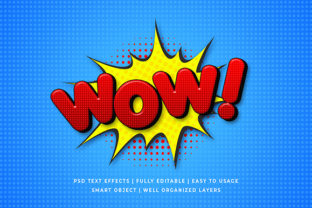
Comic Speech 3D Text Effect Mockup: Where Playful Typography Meets Real-World Design Needs
Imagine handing a client a presentation slide where the headline doesn’t just sit on the page—it pops out with bold, dimensional energy, complete with speech-bubble curves, subtle shadows, and that unmistakable comic-book snap. That’s not animation or video. It’s a Comic Speech 3D Text Effect Mockup: a ready-to-use, high-fidelity design file that places stylized, three-dimensional text into realistic contexts—like a smartphone screen, a printed poster, or even a coffee shop chalkboard.
These mockups aren’t novelty filters. They’re precision-crafted tools bridging visual storytelling and practical communication. Built for designers, marketers, educators, and small-business owners alike, they turn flat copy into memorable, emotionally resonant assets—without requiring advanced 3D software skills or hours of rendering time.
Why This Format Is Gaining Ground—Beyond Just Aesthetics
Today’s audiences scroll faster, skim deeper, and retain less—unless something breaks pattern. Comic-style 3D text does exactly that. Its exaggerated depth, playful contours, and speech-bubble framing tap into decades of visual shorthand: immediacy, personality, and approachability. Unlike minimalist sans-serifs or sterile gradients, this style signals “this matters—and it’s meant for *you*.”
What’s shifted isn’t just taste—it’s workflow. Tools like Figma and Canva now support layered PSD and smart-object mockups, letting non-designers swap text in seconds. At the same time, social platforms reward distinctiveness: Instagram carousels with illustrated headers, LinkedIn posts using expressive typography to highlight takeaways, YouTube thumbnails where bold 3D text cuts through clutter. A Comic Speech 3D Text Effect Mockup fits seamlessly into those moments—not as decoration, but as functional emphasis.
From Niche Experiment to Cross-Industry Utility
Five years ago, comic-inspired 3D text lived mostly in indie game UIs or meme culture. Today, it appears in school newsletters (to engage students), local café menus (to convey warmth and character), SaaS onboarding flows (to simplify complex steps), and even nonprofit campaign banners (to humanize data-driven messages). The evolution reflects a broader pivot: from “professional = restrained” to “professional = intentional, relatable, and context-aware.”
This shift isn’t about chasing trends—it’s about matching tone to audience. A fintech startup explaining budgeting to Gen Z might use a clean, flat interface—but its TikTok explainer could deploy a Comic Speech 3D Text Effect Mockup to label key tips with cartoonish clarity. An educator creating remote learning materials may avoid overstimulation, yet still use one mockup to spotlight a vocabulary word inside a friendly, speech-bubble frame—making terminology feel less abstract, more conversational.
How It Fits Modern Creative Workflows—Without Adding Overhead
Time is the real bottleneck—not skill. Many creators own Adobe Photoshop or Illustrator but lack bandwidth to build custom 3D layers from scratch: adjusting bevel angles, simulating ambient occlusion, aligning perspective grids, then testing across devices. A well-designed Comic Speech 3D Text Effect Mockup removes that friction. Most include:
- Smart object layers—type your message once, and it renders correctly across all depths and lighting conditions;
- Multiple scene variants—a tablet screen, a notebook page, a vinyl sticker, or a storefront window—so you match medium to message;
- Non-destructive color controls—swap fill, outline, and shadow tones without breaking layer effects;
- Print- and web-optimized exports—CMYK-ready for packaging, RGB-tuned for digital ads.
That means a freelance copywriter can drop a headline into a mockup before sending a pitch deck. A solopreneur launching an online course can generate five thumbnail options in under ten minutes. A university communications team can maintain brand consistency while giving each department’s newsletter a distinctive, voice-driven look—all using the same underlying asset.
Real Use Cases—Not Hypotheticals
Consider Maya, who runs a bilingual tutoring service. She uses a Comic Speech 3D Text Effect Mockup to create weekly “Tip of the Week” graphics for WhatsApp and Instagram. Her text (“¡Practica el pretérito!”) appears inside a vibrant, slightly tilted speech bubble against a soft-focus notebook background. Parents recognize her brand instantly—not because of a logo, but because of that consistent, friendly typographic voice.
Or David, a product manager at a health-tech company. His team built an internal dashboard to track user feedback themes. Instead of dry bar charts, he overlays short insights—“Users love the dark mode toggle”—using a muted-toned Comic Speech 3D Text Effect Mockup placed directly over screenshots. Colleagues report higher engagement in sprint reviews, not because the data changed, but because the delivery made it land.
Even educators are adopting them thoughtfully. One middle-school science teacher uses a version with hand-drawn texture overlays to introduce lab safety rules. The 3D effect isn’t flashy—it’s tactile, grounding abstract instructions in something students can almost touch. That’s utility disguised as play.
Choosing the Right Mockup—What Actually Matters
Not all Comic Speech 3D Text Effect Mockup files deliver equal value. Look beyond resolution and file format. Ask:
- Is lighting consistent and editable? Harsh, fixed shadows limit reuse. Layered light sources let you adapt to different backgrounds.
- Does perspective match real-world objects? A mockup showing text on a phone screen should reflect how light hits curved glass—not flat paper.
- Are font pairings suggested—or avoided? Comic-style 3D works best with rounded, medium-weight fonts. Avoid thin serifs or ultra-condensed caps unless intentionally ironic.
- Is licensing clear for commercial use? Especially important for agencies, educators, and SaaS teams embedding assets into client deliverables.
Also consider accessibility: contrast ratios between text and background should meet WCAG 2.1 AA standards—even in stylized formats. Some modern mockups include alternate versions with simplified outlines or higher-contrast variants, acknowledging that expressiveness shouldn’t exclude readability.
Where This Is Headed—Subtly, Not Spectacularly
You won’t see Comic Speech 3D Text Effect Mockup replace clean typography in corporate annual reports. Nor will it vanish as a fad. Its trajectory is quieter: deeper integration into design systems, tighter compatibility with AI-assisted tools (e.g., generating variant mockups from text prompts), and more thoughtful adaptation for inclusive audiences—like dyslexia-friendly letter spacing presets or motion-reduced versions for users sensitive to parallax effects.
The future isn’t about bigger shadows or wilder angles. It’s about smarter scaffolding: mockups that guide ethical usage, suggest tone-appropriate palettes, or auto-adjust sizing for responsive layouts. It’s about treating expressive typography not as ornament—but as infrastructure.
A Practical Starting Point
If you’re new to using these assets, begin small. Pick one recurring need—say, social media quote graphics—and test two versions of the same message: one in standard type, one in a Comic Speech 3D Text Effect Mockup. Track engagement, shares, or even informal feedback (“Which version felt clearer?”). You’ll quickly learn whether the added dimension supports your goal—or distracts from it.
And if you’re already using them? Audit your library. Do your mockups scale across devices? Can teammates update them without asking you? Are you defaulting to the same scene (e.g., always a phone screen) when a chalkboard or sticky note might better suit the message? Small refinements compound—especially when the tool itself is designed to make impact effortless.
In a world saturated with sameness, expressive, well-executed typography remains one of the most accessible ways to signal care, clarity, and human connection. A Comic Speech 3D Text Effect Mockup doesn’t guarantee virality—but it does give intentionality a visual voice. And that, increasingly, is what stands out.