Why Basic 3D Geometric Shapes Are Reshaping Design, Development, and Digital Communication
In today’s visually saturated digital landscape, clarity, efficiency, and scalability aren’t just desirable—they’re non-negotiable. Across industries ranging from product prototyping and architectural visualization to UI/UX design and immersive marketing, a quiet but powerful shift is underway: a return to foundational visual language. At the heart of this movement are Basic 3D Geometric Shapes—cubes, spheres, cylinders, cones, pyramids, and tori—not as nostalgic abstractions, but as functional, interoperable, and future-ready building blocks.
What Are Basic 3D Geometric Shapes—And Why Do They Matter Now?
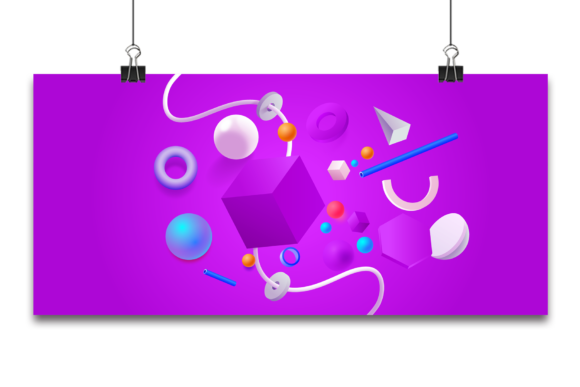
Basic 3D Geometric Shapes refer to mathematically defined, topologically simple volumetric primitives that serve as the atomic units of spatial representation in digital environments. Unlike complex organic models or heavily textured assets, these shapes are characterized by minimal vertex counts, predictable symmetry, consistent normals, and native support across rendering engines, CAD software, game runtimes, and web-based 3D frameworks like Three.js and Babylon.js.
Their simplicity is strategic—not limiting. A sphere isn’t just a ball; it’s a starting point for procedural terrain generation. A cube isn’t merely a box—it’s the bounding volume for collision detection, the scaffold for texture atlasing, and the default mesh for real-time lighting calibration. In essence, Basic 3D Geometric Shapes function as universal reference points: stable, reproducible, and platform-agnostic.
Bridging Disciplines Through Shared Visual Grammar
Historically, disciplines operated in silos with divergent modeling conventions—architects used NURBS, industrial designers relied on subdivision surfaces, and game artists optimized for polygon budgets. Today, convergence is accelerating. Cloud-based collaboration tools (like Figma + Spline integrations), cross-platform AR experiences (Apple Vision Pro, Meta Quest), and generative design workflows demand interoperability. Here, Basic 3D Geometric Shapes act as semantic anchors—common vocabulary enabling designers, developers, and stakeholders to align rapidly without translation loss.
Consider a marketing team launching an interactive product configurator. Rather than waiting weeks for custom 3D asset creation, they begin with parametric cylinders (for bottles), extruded prisms (for packaging), and Boolean-combined spheres and cubes (for modular tech hardware). These primitives allow rapid iteration, real-time A/B testing of form language, and seamless export to WebGL, iOS AR Quick Look, or Shopify’s 3D product viewer—all without sacrificing fidelity or performance.
Driving Efficiency in Creative Workflows
For professionals managing tight timelines and evolving deliverables, time spent on asset preparation directly impacts ROI. Industry data shows that up to 40% of 3D production time is consumed by topology cleanup, UV unwrapping, and format conversion—tasks largely unnecessary when working from clean geometric primitives. When a freelance motion designer delivers a looping animation of rotating, morphing, and intersecting Basic 3D Geometric Shapes, the client receives not just a final render—but a reusable, editable scene file compatible with Blender, Cinema 4D, or Adobe Substance 3D Designer.
This efficiency extends into AI-assisted creation. Modern diffusion models for 3D (e.g., Luma AI, Meshcapade) generate higher-fidelity outputs when prompted with structured geometric references. Describing a “torus wrapped with helical grooves” yields more controllable results than vague terms like “futuristic ring.” That precision stems from shared understanding of what a torus *is*—its radius, tube diameter, and rotational symmetry—making Basic 3D Geometric Shapes essential scaffolding for human-AI co-creation.
Enabling Accessibility and Inclusive Digital Experiences
As regulatory standards tighten—such as WCAG 2.2’s expanded guidance on spatial interfaces—the role of geometry becomes unexpectedly critical. Simple, high-contrast Basic 3D Geometric Shapes provide stronger depth cues, clearer spatial relationships, and more predictable interaction boundaries than photorealistic but ambiguous forms. For users relying on screen readers integrated with spatial browsers (e.g., Apple’s VoiceOver + Reality Composer), well-labeled primitives—“cylinder, height 120px, radius 24px, labeled ‘volume control’”—offer unambiguous semantic context.
Entrepreneurs building accessible VR training modules for manufacturing technicians use stacked cubes to represent assembly stages, color-coded cones to indicate hazard zones, and pulsating spheres to signal system status. These choices aren’t stylistic—they’re cognitive optimizations grounded in perceptual psychology and inclusive design principles.
Aligning With Broader Technological and Cultural Shifts
The resurgence of Basic 3D Geometric Shapes reflects deeper currents: the rise of computational minimalism, the demand for real-time readiness, and the growing expectation of cross-device continuity. Consumers no longer accept static product images—they expect to rotate, zoom, and contextualize items in their own space via AR. Platforms respond by prioritizing lightweight, fast-loading assets. According to Shopify’s 2024 Commerce Trends Report, stores using 3D product views see a 27% increase in average order value—but only when load times stay under 1.8 seconds. That threshold is routinely met using optimized geometric primitives, not dense PBR meshes.
Similarly, in enterprise settings, digital twins of facilities rely on hierarchical assemblies of Basic 3D Geometric Shapes to model HVAC ducts (cylinders), structural beams (extruded rectangles), and sensor housings (spheres with cutouts). This approach enables real-time simulation, spatial analytics, and IoT integration—without overwhelming legacy BIM systems or straining edge devices.
From Concept to Commerce: Practical Applications Across Roles
- Marketers use animated, branded Basic 3D Geometric Shapes in email campaigns (via Canva’s 3D editor) to boost engagement—rotating tetrahedrons serve as dynamic section dividers; morphing cubes become interactive CTA buttons.
- Freelance developers embed responsive Basic 3D Geometric Shapes in client dashboards using React + Three.js—spheres visualize data clusters; animated cones track real-time user flow through funnels.
- Product entrepreneurs validate form-factor assumptions using 3D-printed prototypes derived directly from parametric cubes and ellipsoids—cutting prototyping cycles from months to days.
- Interior designers deploy configurable Basic 3D Geometric Shapes in client-facing configurators—drag-and-drop spheres become pendant lights; scaled cylinders become table bases—each retaining accurate material and lighting properties.
Looking Ahead: Foundations, Not Fads
It would be misleading to frame Basic 3D Geometric Shapes as a trend destined to fade. They are not a stylistic choice like skeuomorphism or flat design—they are enduring mathematical constructs, embedded in GPU architecture, physics engines, and spatial computing SDKs. Their relevance grows as hardware evolves: Apple’s visionOS renders primitives natively; NVIDIA’s Omniverse accelerates simulations built on voxelized geometric cores; WebGPU enables browser-based manipulation of millions of instanced cubes at 60fps.
What’s changing isn’t the shapes themselves—but how deliberately and strategically we deploy them. The most forward-looking professionals treat Basic 3D Geometric Shapes not as placeholders, but as precision instruments: tools for rapid validation, cross-disciplinary alignment, accessibility-first development, and scalable storytelling.
Whether you’re sketching a new app interface, scripting an AR experience, specifying factory automation logic, or pitching a brand evolution, grounding your work in these elemental forms ensures resilience across platforms, audiences, and technological shifts. In an era defined by complexity, the most powerful innovations often begin with the simplest volumes—cube, sphere, cylinder—rendered with intention, optimized for purpose, and extended with meaning.
That’s not reductionism. It’s rigor. And it’s where the next generation of digital creation begins.