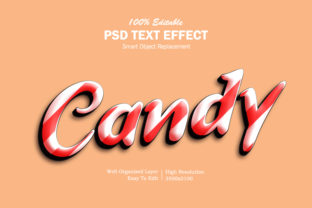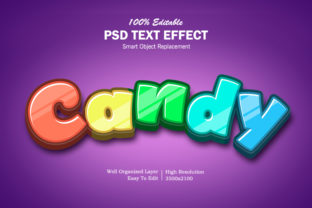
3D Candy Text Effect
If you’ve ever clicked through design galleries, social media reels, or email headers and paused at text that looks like it’s been dipped in glossy sugar—vibrant, rounded, with soft shadows and a playful sheen—you’ve seen the 3D Candy Text Effect in action. It’s not just eye candy—it’s a deliberate visual cue that signals fun, approachability, and creativity. Brands launching kid-friendly products, educators making learning materials pop, bloggers highlighting key takeaways, or small businesses designing Instagram story banners often reach for this effect to add warmth and memorability without heavy illustration work.
Why It’s Misunderstood—And Why That Matters
Many assume the 3D Candy Text Effect is “just a filter” or a one-click Photoshop preset—and that’s where things go sideways. In reality, it’s a layered technique relying on precise combinations of bevels, inner glows, subtle gradients, ambient occlusion, and sometimes even texture overlays. When applied poorly—say, using low-resolution assets, mismatched lighting angles, or inconsistent gloss intensity—the result isn’t joyful; it’s flat, confusing, or unintentionally cheap-looking. Worse, some creators unknowingly use outdated or overcompressed resources (like PNGs with jagged edges or embedded raster shadows), which scale poorly across devices or print formats.
1. Assuming All “Candy” Effects Are Created Equal
Not every 3D Candy Text Effect delivers the same depth or realism. Some rely solely on outer glow + basic bevel, giving text a “halo-and-bump” look rather than true dimensionality. Others simulate surface texture (like a gummy bear’s slight translucency or a hard candy’s sharp highlight) using layer blending modes and gradient maps—but only if your software supports them. If you’re using Canva or a basic online generator, you may get stylized approximations, not editable, production-ready layers.
Better approach: Test before committing. Download a free sample pack from a reputable source (look for PSD or Figma files with labeled layers—not just JPEG previews). Open it in your preferred editor and inspect how highlights align with the light source. Do shadows fall consistently? Can you adjust saturation or gloss intensity without breaking the illusion? If not, keep looking.
2. Ignoring Context and Contrast
A vibrant pink-and-yellow candy effect might shine on a pastel background—but vanish against a busy photo or dark gradient. Equally problematic: applying it to thin, light-weight fonts. The effect needs enough letterform mass to hold shape and shadow. Try it on a hairline sans-serif, and you’ll get blurry halos instead of crisp dimension.
Real-world example: A freelance educator used a candy-text headline in a slide deck about childhood nutrition—great idea! But the font was too narrow, and the background had a faint fruit-pattern overlay. Viewers missed the title entirely during a live presentation. Switching to a medium-weight rounded sans (like Quicksand or Nunito) and adding a subtle semi-transparent white backing improved legibility instantly—without losing charm.
Better approach: Always preview at actual size and on target devices. Ask: Does the text stand out at arm’s length? Is the highlight readable under office lighting or mobile screen glare? Use tools like browser dev tools or Figma’s device preview to simulate real conditions—not just your high-end monitor.
3. Overlooking File Format and Export Settings
Here’s what often slips through: exporting a candy-text logo as a JPG for web use. JPGs flatten transparency and compress gradients, turning smooth gloss transitions into visible banding. Even worse, some generators output SVGs with embedded raster effects—so when scaled up for a banner or printed poster, the “candy” parts pixelate.
Better approach: Match format to function. For web: use SVG *only* if the effect is built with vector-compatible techniques (e.g., CSS box-shadow + radial gradients). For print or high-res displays: stick with layered PSD or PDF/X-4 with preserved transparency and embedded fonts. And always export a version with alpha transparency—never a white background—unless you’re certain it’ll only appear on white surfaces.
What to Check Before You Download, Buy, or Build
- Software compatibility: Does the resource require Adobe After Effects for animation—or does it work in free tools like Photopea or Figma? Check documentation, not just the thumbnail.
- Font licensing: Many candy-text kits include custom typefaces. Verify whether those fonts can be embedded in client deliverables or shared presentations—especially if you’re a freelancer or agency.
- Lighting consistency: If you’re combining candy text with 3D icons or illustrations, do their light sources match? A top-left highlight on your text but bottom-right shadows on your icon creates visual dissonance—even if both look great alone.
- Accessibility awareness: Glossy effects can reduce contrast. Run your final composition through a contrast checker (like WebAIM’s tool). Aim for at least 4.5:1 against its background—even with candy flair, readability must come first.
Learning It Yourself? Start Small—Then Scale Smartly
You don’t need advanced 3D modeling software to understand the principles behind the 3D Candy Text Effect. Begin by studying real candy: notice how light catches the curve of a lollipop, how moisture creates a hotspot near the edge, how color deepens slightly in recessed areas. Then replicate that logic in layers—bevel for shape, inner glow for subsurface scattering, gradient overlay for directional light.
Many beginners jump straight into complex tutorials with 12-layer stacks. Instead, try this: Create one word in your design app. Apply only a subtle inner shadow (1–2px, softness 3, opacity 15%) and a single directional outer glow (color-matched to your text, spread 0%, size 6px). That’s already 80% of the effect—and fully editable.
As you grow more confident, layer in texture (a faint noise overlay set to Soft Light at 8%), then fine-tune highlight placement using a white brush on a new layer (blending mode: Linear Dodge, opacity 20%). Each step adds realism—not clutter.
Final Thought: It’s About Intention, Not Just Shine
The 3D Candy Text Effect works best when it serves a purpose—not just decorates. Does it guide attention? Reinforce brand personality? Make instructions feel friendlier? If the answer is yes, and you’ve checked compatibility, contrast, and context, then you’re not just applying an effect—you’re communicating with clarity and care. That’s what turns a flashy detail into lasting impact.