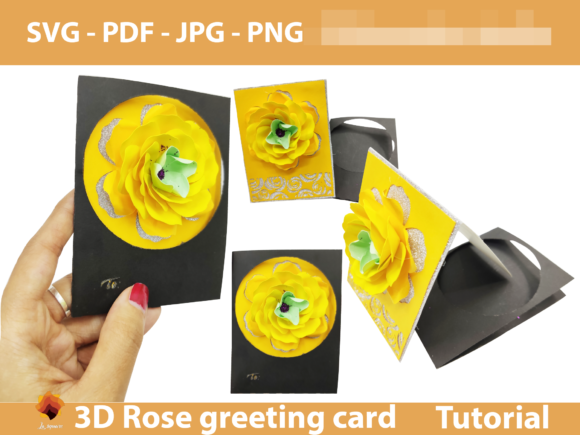
How a DIY 3D Rose Valentine Greeting Card Transforms Meaningful Connection into Tangible Craft
Valentine’s Day is often defined by gestures—flowers, chocolates, dinners—but what endures beyond the moment is resonance: the quiet weight of something handmade, thoughtfully assembled, and emotionally precise. Among contemporary paper crafts, the DIY 3D Rose Valentine Greeting Card has emerged not as a passing trend, but as a convergence point for tactile expression, accessible engineering, and heartfelt communication. It bridges generational divides—teenagers cutting layered petals with craft knives, educators guiding students through symmetry and spatial reasoning, small-business owners prototyping limited-edition stationery—and does so without requiring specialized tools or formal training.
Why Dimension Matters in Emotional Expression
Flat cards carry sentiment, but dimensional objects invite interaction. When someone opens a DIY 3D Rose Valentine Greeting Card, their fingers trace the curve of a petal, their eyes follow the spiral ascent of layered paper, and their attention lingers—not because it’s flashy, but because it asks for presence. This isn’t passive consumption; it’s participatory meaning-making. Research in environmental psychology suggests that three-dimensional stimuli activate broader neural pathways than two-dimensional ones, enhancing memory encoding and emotional salience. In practice, that translates to a card placed on a desk for weeks, not tucked into a drawer after reading.
The rose itself is no arbitrary choice. Botanically, roses encode complexity—overlapping petals, gradients of color, subtle asymmetry—making them ideal for paper modeling. Unlike geometric origami, which prioritizes precision folds, the DIY 3D Rose Valentine Greeting Card embraces organic variation. A slightly uneven petal doesn’t break the illusion—it deepens authenticity. That tolerance for human imperfection lowers the barrier to entry while preserving artistic integrity.
Core Components and Their Functional Roles
A well-constructed version of this project rests on four interdependent elements:
- Base structure: Typically a folded A5 or square cardstock foundation (120–180 gsm), chosen for rigidity and fold memory. Thinner stock sags under layered weight; thicker stock resists clean scoring. Recycled cotton fiber paper adds texture and subtle sheen without compromising cutability.
- Petal stack: Usually 5–7 graduated layers, each cut from progressively smaller templates. The smallest layer forms the tight bud core; the largest flares outward like a blooming hybrid tea rose. Laser-cut kits exist, but hand-cutting with a fine blade and self-healing mat teaches proportional judgment—a skill transferable to graphic design, model-making, or even architectural sketching.
- Stem-and-leaf assembly: Often overlooked, yet critical for visual balance. A twisted green paper strip mimics vascular tissue; die-cut leaves provide counterpoint to floral density. Some makers embed dried lavender or rosemary between layers—not for scent alone, but as multisensory reinforcement of theme.
- Interior integration: The hidden narrative space. Rather than a blank back, the interior may feature embossed coordinates of a meaningful location, a micro-poem typeset in variable-width font, or a QR code linking to a voice memo. This transforms the DIY 3D Rose Valentine Greeting Card from object to interface.
Real-World Applications Across Diverse Contexts
The versatility of this craft extends far beyond romantic exchange. Its adaptability reveals how form follows function—and sometimes, function evolves from use.
Educational Settings: Geometry Made Visible
In middle-school math units on radial symmetry, teachers use scaled-down versions of the DIY 3D Rose Valentine Greeting Card to demonstrate rotational transformation. Students measure petal angles, calculate area ratios between layers, and observe how minor changes in scaling produce dramatically different volumetric outcomes. One Montessori classroom in Portland documented a 40% increase in retention for fraction concepts when taught alongside physical petal-layering exercises versus digital simulations alone.
Therapeutic Practice: Repetition as Regulation
Occupational therapists working with adults recovering from stroke or anxiety disorders incorporate controlled cutting and layering into fine-motor rehabilitation. The rhythmic motion of tracing and cutting identical petal shapes provides proprioceptive feedback, while assembling depth requires sustained visual tracking—both foundational for daily task reintegration. A 2023 pilot study at the University of Minnesota noted measurable reductions in cortisol levels among participants who completed three consecutive sessions building simplified 3D rose cards.
Small-Business Innovation: From Prototype to Product Line
Independent stationers increasingly treat the DIY 3D Rose Valentine Greeting Card as a modular system. Instead of selling finished cards, they offer downloadable templates paired with sustainably sourced paper packs—allowing customers to personalize color palettes, add foil accents, or integrate custom typography. One Brooklyn-based brand reported that template sales grew 217% year-over-year, outpacing physical card revenue, precisely because buyers valued co-creation over passive receipt.
Material Intelligence: Beyond “Just Paper”
Selecting materials isn’t about aesthetics alone—it’s about structural behavior. Vellum behaves differently than kraft paper, which reacts differently than metallic cardstock. Each responds uniquely to humidity, pressure, and adhesive chemistry.
For example, double-sided tape works reliably for thin layers but causes buckling in thicker stacks due to uneven tension. Acid-free PVA glue applied with a fine-tip brush allows controlled drying time and minimal warping—ideal for archival longevity. And while glue sticks seem convenient, their polymer base can yellow paper edges within months, compromising the delicate contrast essential to the rose’s realism.
This material literacy transfers directly to packaging design, bookbinding, and even textile prototyping. Understanding how grain direction affects curl, or how surface sizing alters ink absorption, turns casual crafting into applied material science.
Workflow Nuances That Separate Good from Exceptional
Two often-overlooked steps define quality in execution:
- Scoring before folding: Running a bone folder along intended crease lines—especially on thicker stocks—prevents fiber tear and ensures crisp, repeatable bends. Skipping this leads to “soft” roses that lack structural authority.
- Progressive layer adhesion: Rather than gluing all petals at once, experienced makers attach one layer, let it set for 90 seconds, then add the next. This prevents slippage, allows micro-adjustments, and avoids trapped air pockets that distort petal curvature.
These aren’t rigid rules—they’re observations refined across thousands of iterations. A high-school art teacher in Austin developed her own “petal alignment jig” from repurposed binder rings and elastic bands after noticing consistent misalignment in student work. That kind of adaptive problem-solving is where pedagogy meets making.
Scaling Thoughtfully: When to Simplify, When to Expand
Not every context demands full botanical fidelity. A kindergarten class might use pre-cut foam petals glued onto cardboard stems—retaining dimensionality while prioritizing safety and motor development. Meanwhile, a professional greeting card designer may extend the concept into kinetic variants: a rose that unfurls when the card opens, or one with translucent acetate layers that shift hue under changing light.
The DIY 3D Rose Valentine Greeting Card scales not just in complexity, but in intention. A minimalist version—single-tone paper, no embellishment, stark negative space—communicates quiet devotion. A densely layered variant with gold-foil stamens and pressed flower inclusions signals ceremonial care. Neither is superior; both are calibrated to audience and occasion.
Sustainability Considerations Embedded in Process
Unlike mass-produced novelty cards laden with plastic coatings and non-recyclable laminates, most DIY iterations prioritize circularity. Scrap paper from earlier layers becomes confetti filler or decorative envelope liners. Leftover petal cutouts serve as stencils for future projects. Even failed assemblies—roses that collapsed mid-construction—are deconstructed, fibers re-pulped, and recast as handmade paper sheets.
This closed-loop mindset aligns with growing consumer demand for transparency. Buyers increasingly ask not just “What is this made of?” but “What happens when it’s done serving its purpose?” The DIY 3D Rose Valentine Greeting Card answers that question with built-in obsolescence planning—because its value lies in creation and experience, not perpetual display.
Looking Ahead: Where Craft Meets Context
Emerging intersections suggest continued relevance. Augmented reality apps now allow users to scan completed cards and view animated growth sequences—buds blooming in real time. Universities are integrating parametric design software so students generate custom petal algorithms based on mathematical functions (logarithmic spirals, Fibonacci sequences). And community workshops in Detroit and Lisbon report rising enrollment not for “Valentine’s craft nights,” but for “dimensional storytelling labs”—where the rose is merely the first module in a broader curriculum on embodied narrative.
Ultimately, the DIY 3D Rose Valentine Greeting Card endures because it refuses to be reduced to a seasonal artifact. It is a vessel for patience, a scaffold for learning, a testbed for material innovation, and a quiet assertion that some messages require more than words—they require shape, shadow, and the unmistakable warmth of human hands at work.